Why Uzbekistan?
Over the years since we hosted Dilmurod, a foreign exchange student from Uzbekistan, 2002-03, we talked about visiting him. Then in December, 2011 we were invited to his wedding. Since it was with only a 10 day notice and holiday time, we delcined. However, we were later informed that the family was holding off his brother's wedding until we came, hopefully before September 1st. Thus the genesis and timing of my trip to this far-off land. Due to the distance and conditions for such a trip, Mary thought it best not to accompany me.
Background of region and culture
The wedding was held in town of Asaka located in the Fergana Valley of Uzbekistan and home of the auto plant for GM Uzbekistan. This fertile valley is separated from the rest of the country by mountain ranges. It tends to be more ethnically homogeneous and traditional than other parts of Uzbekistan. Almost everyone is Muslim.
Courtship
Men and women of marriageable age have little interaction with each other and dating is seldom done. So courtship as we know it rarely occurs. What does happen is the aunts of the young man seem to on the constant outlook for possible marriage partners. When a candidate is found, the mother of the man goes to the prospective woman's house to meet her family and be introduced. If both families agree, a supervised meeting is then arranged between the young man and woman.
At this meeting the young man or woman decide whether they like each other. If not, the search continues. If they do, they usually meet again a couple of times to get to learn more about each other. The wedding is quickly arranged. Women tend to be in their early 20's while men are a few years older.
In speaking with an imam (Muslim cleric) who was to conduct the marriage, I asked him what he looked for in finding a partner for each of his 10 children. He stated the most important thing was the character of the other family and the compatibility of the couple, not only with each other, but of the woman with the man's family. Money was not important. He even frowned on marriages done for money. Instead was the ability of the couple to learn to live with each other and to anticipate future difficulties. The idea of couples meeting and wanting to get married on their own was something he recognized as a growing trend, but also thought the couples may be shortsighted in understanding the importance having the input of more experienced married people.
Conversing with imam
Wedding Day 1
August 25, 2012
Welcoming of Honored Guest
What a surprise to step out of the car at Dil's and the groom's house (Dilmurod's brother) to find myself in front of a white runway with a veiled young woman (Dilmurod's wife) ceremoniously bowing three times to me.
Then band started playing
and the dancing began.
I was presented with a ceremonial robe (later removed due to 100 degree temp) and as the custom, money was inserted into various clothing parts by spectators who liked the way you danced. Everyone joined in, even grandmothers.
One reason I seemed to getting a lot of money was the fact, unknown to me, that I moved my hips as I gesticulated to the sounds of traditional Uzbek music. Uzbek's flail their arms and legs wildly while keeping hips straight.
.
As evening approached, the bride's family brought food for the groom's friends
who were to gather that evening.
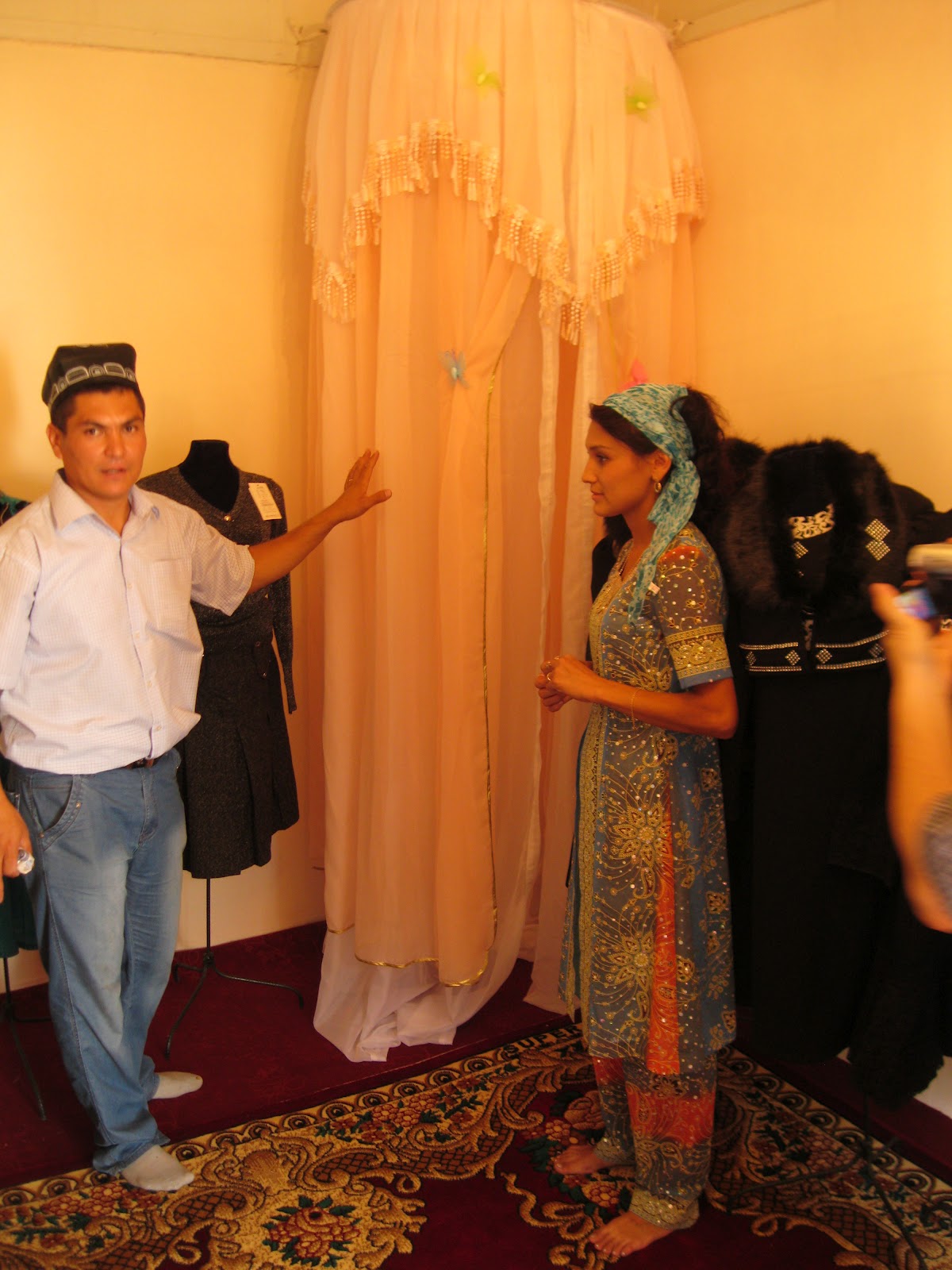
Next the bride's female family members brought all the bride's belongings and what we may call trousseau which the bride's family had been preparing since childhood. The two small rooms which the bride and groom would later live in was completely furnished with the bride's possessions.
Inside bride's new room where her dresses were on display as well as this canopy
from which she was to emerge when she her husband visits her.
(Pictured are Dilmurod and his wife)
Later that evening the groom and his friends arrive for a kind of alcohol-free bachelor party. The groom is a policeman as were most of his friends. I believe the bride has a similar gathering at her house with her friends.
Men gather at the house to discuss important issues and to meet a Westerner.
Since we arrived late from Tashkent, I did not do the "Spilling of Blood" ceremony where as "Honored Guest" I was to cut the throat of a sheep upon my arrival. The sheep had been killed a couple of hours before my arrival due to the time needed for food preparation.
Wedding Day 2
A nervous groom and his accompanying friends prepare to go to the bride's house
where the Muslim part of the marriage is to occur.
While the mother's of the groom's friends gather at the groom's house.
Piluf is prepared at a neighbor's house for the reception.
The Muslim part of the wedding takes place at the bride's house in the neighboring city of Andijon about 7 miles away. Here the imam sits with the groom in one room while in another room with the door slightly ajar he lectures the couple on their duties, responsibilities, and roles. He then asks each separately whether they fully agree to be married. The groom leaves, the bride remains in her room.
Imam and groom
Woman sewing thread into groom's coat, the meaning of which I never found out.
With much fanfare, loud horns, and dancing the bride emerges from her house in her rented wedding dress.
The couple leaves for the civil wedding ceremony while inside and outside guests party.
It is then off to the groom's Asaka City Hall for the civil and legally binding wedding ceremony.
Entering city hall wedding room
Civil ceremony and signing of marriage documents. Exchange of rings.
Wedding party
Officially married. No kissing, hugging, or screaming.
Leaving city hall.
Note bride's veil is down
Bride goes to groom's house for the very first time where she is greeted by the women of her new family.
More dancing. More money.
Dressed to kill.
Dilmurod's pregnant sister and wife.
Note: Please excuse the lack of photos with the following descriptions. My camera was not working and the wedding photographer never got his promised CD of photos to me before I left.
The bride then returns to her house. The groom leaves with friends.
Guests return to the bride's house where she comes out completely covered by a special robe and wearing boots. She no longer is wearing her wedding dress. She has to be guided by her "bride's maids" since she can see very little. It is very emotional as her family bids her farewell.
With horns blaring, drums beating, people dancing, the bride is then lead to the "Wedding Bus" where her brothers try to steal her back in an effort to prevent her leaving. Women hover around her to keep her covered and to protect her. The bus is packed like sardines as riders sing and just enjoy the moment. The bride hidden under her robe is silent. As the bus reaches the house, bundles of cotton branches are burned to welcome her. While still covered, she is lead to her room.
Later she emerges in her wedding dress, groom at her door, and under a ceremonial fabric go to the wedding reception tent on the street in front of the house. There they sit at a table greeted and are congratulated by relatives and friends. Wedding cake is cut. More dancing. Different band and music. Women sitting on one side of the aisle, men on the other.
During the reception, the bride is taken to her room where she is sequestered for the next few days. Food is brought to her. Only coming out while accompanied and covered to use the toilet. Groom stays at head table joined by friends, most guests having left.
During that entire night the bride and groom talk as each sits on a pile of pads in their room at the groom's house. Groom leaves before dawn to stay with friends. Bride remains unseen by others.
Wedding Day 3
Bride comes out again fully covered in robe and boots where she she ceremoniously bows three times to her father-in-law (and me) amongst women of her new family. She then kneels before father-in-law and rubs her hands symbolically three times each with flour, the piluf (local rice dish), and candies. This ceremony is the father-in-laws welcome into the family and the only time a man takes part in the wedding ceremony. Weddings are definitely a female run affair. The bride returns covered to her room.
The bride's family brings food for her and members of he groom's family for her meals.
That night, a woman who specializes in the conjugal affairs comes to check the bride to see if she is menstruating. If not, to instruct the bride as to what she might expect from the groom. The groom returns after being with his friends and likewise talks to his father who instructs him to be gentle.
The marriage is consummated on a white cloth to collect the bride's blood and to confirm the couple's union. Aunts are always nearby. The groom stays the entire night, leaving before dawn. The cloth is checked and kept as a memento of the event, much like keeping the statue of bride and groom on a wedding cake.
The wedding is over.
W Day 4
The groom (Dilmurod's brother) returns to the house. Visits with his wife. A sheet is put up in the court yard to give the couple additional privacy.
W Day 5
Bride finally comes out of her room and publicly is seen for the first time.
Bride is 23 years old, groom 27.
W Day 6
Wedding is over. Bride begins to help with household duties. She may seldom visit her own family in the months ahead as she experiences home sickness and her integration with her new family.
Thoughts
At first glance this wedding and the role of women may seem barbaric to some. But living in a house without running water, little money, the amount of work required just to maintain the house, and cooking the meals leaves little free time. Just how different the role of today's working woman is debatable, for being obligated to earning a salary to pay for life's essentials seems little removed from the obligations faced by this bride.
The women I met seem like a happy lot and truly enjoyed being with other women. Yet as money becomes more important in their lives and as education leads them into new careers, maybe away from home, I sense they may one day look back on the "good old days" where roles were defined and stability prevailed.


 Entrance Drive to Offices