Showing posts with label Samoa Challenge III. Show all posts

Friday, September 2, 2011

Flocculation

September 1, 2011


Clear Extra Virgin Organic Coconut Oil as it usually appears in Samoa


Same oil undergoing flocculation in Minnesota


Extra virgin organic coconut oil is the main economic venture promoted by the NGO, Women in Business Development(WIBD), with whom I was associated during my Health Challenge project in Samoa. The oil is wonderful stuff used by Samoans for body massages and hair oil, some others for cooking, and exported to the Body Shop in the U.K. to make cosmetics. When the bottles of coconut oil I brought back turned from a crystal clear liquid to a white solid, I began to wonder why. This could be a serious problem.


A clue to the puzzle is on the label of a coconut massage oil I brought back from Samoa in 2009. It states the oil turns solid under 72 degrees F. It is also the reason why this massage oil has never been used by me in Minnesota and why my clear oil turned to a solid. These are conditions never experienced in Samoa.

My emails to WIBD about my observations have so not been replied. This may give you some idea of the conditions I experienced in Samoa.

Monday, August 29, 2011

Departing Thoughts

August 25, 2011


Was it worth it? I mean leaving my family to return to Samoa as a Peace Corps Response Volunteer.


For me, yes. For others, I guess you have to ask them.


What I wanted to do more than anything else was to significantly impact the way Samoans relate weight to health. Obesity is the “Elephant in the room”. It is so big as to be almost unrecognizable by those in the room and seemingly too big to tame. Yet, obesity is the reason why so many Samoans suffer from its effects of diabetes, hypertension, sleep disorders, gout, and joint problems. It saps the strength of this tiny and once vigorous nation.


Call it a gimmick or a stroke of understanding, but 5,000 pink vinyl wristbands, a Samoan BMI chart, and Biblical verses served as my entry into the Samoan mind. They served to demonstrate how a simple program, offering a simple message, and being demonstrated in a simple, yet Samoan way, can affect people’s behavior. The monster could be tackled, only if the “man in the mirror” cares to recognize the problem as his own.


It is now time to collect and analyze the data. A concluding report needs to be written and hopefully read. The data and report cannot convey the feeling of a woman who is having sex again or a person who feels better because a wristband can be slipped off a once chubby hand, or people walking, or drinking water, or taking the salt container off the table. Samoans, like anyone else in the world, want to look, feel, and be better.


What is next for me?


For the Peace Corps there is a report on ways volunteer teachers can provide some health education for children, parents, and teachers where none exists today, and to see if an organization would sponsor another Peace Corps Response Volunteer.


For my nascent efforts with the Ministry of Education, Sports, and Culture, their Sports for Development program and the Australian Sports Authority who are sponsoring that program, I have a sense of a continued relationship in the months ahead. Their combined resources are what are needed to affect real change.


Finally, it is off to a West Virginia mountain top camp, along with others who served with Mary and me, over Labor Day weekend to attend the wedding of Hannah Goldman and her Samoan fiancé, Jay. Then there is a trip to The Gambia in Africa next month to visit another Peace Corps Volunteer.


My Peace Corps luggage tag reads, “Life is calling. How far will you go?”


I wish I knew the answer.


I do know how lucky I am to have the opportunity to apply what few skills I possess and to have an understanding, supportive family.


Now it is time to start my 48 hour journey back home to those whom I love.

Dinner with Dale

August 24, 2011


Dale Withington is the Peace Corps Country Director in Samoa. He is also a former Peace Corps Volunteer in the Philippines and Country Director of Peace Corps in Micronesia. Probably his most noteworthy achievement is to marry, Lucy, whom he met while living in Indonesia. Besides being beautiful, Lucy is a great cook, and I love Indonesian food.


For my last dinner in Samoa, Dale invited me to join his other guests for one of Lucy’s “little meals”.


Dale Withington. Lucy, and family.
Lucy's meal.

Ben's Garden

August 20, 2011

Ben Harding is a volunteer from my original Peace Corps Group 78 who married to a Samoan beauty and is staying on living with her family at his Peace Corps village on Savaii. Ben and I share a passion for gardening. Ben is more serious and successful than I ever could be.


Ben Harding and his garden

Ben's special variety of Bok Choy, Chinese Cabbage, grown for more seeds.

Stolen Wristbands

August 20, 2011


Nothing is ever stolen in Samoa, things just go missing.


The next morning after the Rock da Boat experience, I take the ferry to deliver awards to some of the volunteers on the island of Savaii who did not make trip into Apia, to spend the next two nights with my old host family in the Village of Iva, and specifically to have a rare Sunday meeting with the head nurse at the hospital on Savaii to deliver 120 wristbands for the island’s hospital staff.


When what to my panicky eyes should appear at the farthest point of Savaii is my car sans wristbands. The wristbands are the reason for my trip.


The missing wristbands can only be at one of the following: the Peace Corps office, the Maona Blue Restaurant, or my house, all of which are in Apia, a long and ferry ride away.


I have to admit to driving slightly above the 25 mph Samoan speed limit to reach the last ferry of the day three minutes before it leaves the wharf.


No wristbands at the Peace Corps office in Apia.


Next, the floating restaurant where the employees proudly show me their wristbands of which I have no recollection of giving them. An empty wristband box under a table is an indication I may be on to something. Upon further inquiry wristbands emerge from deep within a drawer behind the bar, and my surgical scissors from the manager’s purse. Everyone is happy.


Early the following Sunday morning, it is back to the ferry and Savaii to continue my trip minus an unknown number of pink wristbands.


Rock da Boat Recognition Dinner

August 19, 2011

One of the nagging issues with being a Peace Corps Volunteer is not to be recognized for your service. No one seems to care or notice the fact you are in some remote, dirty school, trying your best to teach children English so they can get a job later in life.

Being in sympathy with their plight and having reallocated my Health Challenge Grant, I held a Recognition Dinner on a floating restaurant in Apia harbor, Maona Blue, followed by a harbor “Rock da Boat” cruise. Also all 30+ participating Health Challenge volunteers received a hand sewn gift made by the beloved Peace Corps nurse, Teuila Pati.

Below are some pictures of the event:


Dinner aboard the "Maona Blue" floating restaurant

Chelsea Kovacs, Lilly Watson, and Rachel Goldstein
A Vailima bottle, Chelsea, Rachel, and Matt Kaplan

Chris Rocchio with Clint, a pharmacist at the National Hospital

and supplier of my diabetes testing equipment.

Rivka Rocchio, Olivia Hanson. Kate Klane, Rachel Camp, and Mike Jeter

Jenny McCracken, Dan Butterfoss, Mike Aboraand, and Kalien O.

Alberta Malielegaoi, the Prime Minister's daughter, and me

Robert Gonzales Kareoke with Jenny Sutherland and Rachel Camp


Da Boys on Da Boat

Mike Jeter, Chris Rocchio, and Devon Childress

Samantha Marenell at Falefa

August 17, 2011


It had to happen, the last primary school to be tested and receive wristbands.

This one is in the Village of Falefa. The Peace Corps Volunteer teacher is Samantha Maranell from Wascea, Minnesota.


Many schools have a day where teachers all wear the same outfit. This outfit is one of my favorites. In the middle is the school principle. Two down from her left is the he/she teacher appropriately dressed in a different outfit. You have got to love Samoa!

Falefa children wristbandized.

Wednesday, August 17, 2011

Hand of God

August 13, 2011


When Divine Intervention happens, you should not question the how or why. Here is my D.I. story.


While rushing to catch the ferry back to the island of Upolu and being hungry because there was no power at the Sekia Pizza stand on the north side of the island, I heard a strange knocking sound coming from my rental car’s engine. I pull into a parking spot in front of a Salelologo store where there is usually a person selling barbeque something. No barbeque, but also no starting of my car.


A panic begins to settle in as my ferry is at the dock and waits for no man. I mentally start to run down the list of possible problems. Battery, no. Gas, no. Must be under the hood. But as I emerge from the car, a man is already lifting the hood. He checks the oil. No oil. The radiator. No water. My God, this is serious. Father’s Day weekend in Samoa is like Christmas Day in the U.S. You may not get help until after New Year’s.


The man tells me the store sells oil as he sends a boy to get water for the radiator. He confidently adds oil and water, turning the engine with each addition to insure proper lubrication and cooling.


Who could this man be? I ask him his name and tell him mine.


“I know”, he says as he puffs on his cigarette, “you lived with the Kapeli family in Iva. I am the acolyte at the Catholic Church in Saleavalu.”


“I didn’t recognize you without your robes”, I humbly say, swallowing hard.


Such is Samoa, a small island country touched by the Hand of God.


P.S. The car seems to be running fine. Hope it lasts for the next ten days.


Exercise, Samoan Style


August 12, 2011


Samoans relate exercise to health. In fact next to prayer, exercise is the elixir for a long life. When I mention a “health program”, Samoans immediately think it is an exercise/dance program; the idea of what or how much you eat just isn’t even a passing possibility. There is little wonder that the millions spent on loudspeaker systems and “exercise” programs has done next to nothing in combatting the tsunami of diabetes and hypertension.


One can hardly accuse Samoans for their health situation when even their government refuses to acknowledge what all their leaders are, obese. Yet despite all obstacles, Samoans are extremely interested in their health and will get up early in the morning or afternoon to do what they have been told makes them healthy, size or diet never being mentioned.


The following video shows an exercise session in the Village of Patemea, on Savaii. Normally there are about 30 women who participate, but this Friday afternoon before the major holiday of Father’s Day, only a few showed up for exercise. Later after I joined the dance group, it became apparent they could be weighed, showed where they stood on a BMI chart, and receive a bottle of honey, the numbers grew.


Testing on Savaii


August 12, 2011


Here are some more photos of Peace Corps teachers helping in the screening for diabetes and hypertension while trying to inform the citizenry about BMI and the relationship between weight and health while distributing flyers and wristbands to school children.


Olivia Hanson

Jenny Sutherland


Rachel Goldstein and Sina


August 11, 2011


Rachel Goldstein is a rural primary school Peace Corps teacher. Whenever I have the opportunity, I try to show these volunteers my and their government’s appreciation by taking them out to dinner after a day of testing. This time I had the honor of having Rachel Goldstein join me for dinner at Stevenson’s Resort in Manase.


Of course Rachel is lovely standing before the gigantic carved mural. The mural depicts a Samoan legend, dear to all Samoans, of how the coconut, Samoa’s most important food, came to this island in the middle of the Pacific. But what is fascinating, besides Rachel, are the words above the mural. In English, it is “Sina and the eel”; in Samoan, it is, “Sina ma lana tuna.”


The Samoan language has gender neutral pronouns. You intuitively add the gender possession to the sentence’s subject. Back to Sina.


The translation from Samoan to English should be, “Sina and her eel”, tuna being the Samoan word for eel, lana the pronoun. As every Samoan knows, the legend is a very sexual one, as the tuna seduces Sina. “The” instead of “her” completely changes the whole relationship of the legend, changing the mural from a deeply significant relationship, full of questions for the unknowing, into an interesting carving of a girl and an eel.


“Sina and her eel” typify the problem of understanding between peoples and cultures. What sounds like bombastic rhetoric when translated from another language to English, may be nothing more than flowery poetic words or visa versa. We may never know the meaning and the exact translation may be impossible; yet we must try.


Living in amidst a different culture is like “Sina and the (her) eel”. It is a constant struggle of getting through each day, thinking you know what is happening, but really being totally clueless. At the end of the day, you collapse from the exhaustion of simply coping. Of course, there is a solution of simply killing them all, but that is job for the other “Corps”.


Thursday, August 11, 2011

What I am learning

August 7, 2011


When I look back on these past months and weeks, I feel they have been more of a learning process in attempting to find ways to better Samoan’s health and lives. Here are a few of my thoughts.


Ignorance is Not Bless


There is almost no attempt by schools and health departments to educate Samoan adults and children about the effects of obesity. Simply weighing people and determining what color on a Samoan BMI chart (red being obese, yellow overweight, green normal) raises their attention level and concern. Providing easy-to-read health tips gives some information they can use to reduce weight. The National Health Service does screen rural villages, but unless they are critically ill, which many of the elderly are, they receive no preventative medical information. The schools likewise have no consistent health program for students or parents. When authority figures from the Prime Minister and other governmental ministers, to nurses, to teachers, to village mati, to ministers are among the most obese, it is understandable of their reluctance to tackle the subject. But, tackle it they must, if they are to serve the citizenry. It is not that Samoans think being obese is beautiful or their fate; it is they simply don’t know how to prevent obesity and its consequences.


Role of Peace Corps


All Peace Corps Volunteers in Samoa are now teachers of ESL in rural primary schools with a secondary mission of community health. The school is their world and any health program needs to have as its base, the school. When teachers are screened or find out what color they are on the BMI chart, obesity becomes a personal subject affecting them. They realize their role in teaching youngsters about obesity is also their role of parent and spouse. The teachers get the message making it easier for the Peace Corps Volunteer to conduct health education, not only in the school, but bringing them in contact with the wider community. The Peace Corps experience becomes more rewarding.


The Bible


Samoans may not understand Western concepts of BMI ratios, nutrition, calories, vitamins, cholesterol, etc., but they do understand that what is said in the Holy Bible is an indisputable fact. Fortunately, the Bible has passages on taking care of “God’s body” and the sins of overindulgence and gluttony. The Bible is how to be understood in Samoan.


The Message


The concepts of obesity and resultant diabetes, hypertension, and joint problems are difficult for anyone to comprehend, let alone change life-long which are the leading causes. The message needs to address the major causes in a language which is understood and is doable. Since the causes of obesity are many and varied, one needs to choose the message and cause carefully. Water and salt are messages I find easily understood and doable.


Water: Samoans drink very little of it. The water they do consume is sweetened in the form of koko Samoa, tea, and soft drinks. The amount of sugar consumed in a day by the average Samoan can range from 10-100 tablespoons of sugar a day. Samoans start heaping tablespoons of it when they get up and throughout the day, ending just before going to sleep. Sugar is probably the single biggest expense any family spends on food. How this habit started, I don’t know, but I do know a lot of what they drink is because they are thirsty. Their body’s grave water, their taste buds trained on sugar.


My message is “Water comes from God (the sky, heaven), unsweetened. Sugared drinks are to make money, not for your health. Drink two glasses of water when you wake up, and 10-15 minutes before you eat. You won’t be as thirsty for sweetened drinks. Carry water with you. Drink it when you are thirsty or hungry”. I bring a bag of only 150 tablespoons of sugar and a Coke bottle with a corresponding amount of raw sugar as a demonstration. Of course, they ask whether I plan to leave the bag of sugar at the conclusion of my demonstration. My homily is longer than this, but you get the message and the depth of the problem.


A liter of bottled water cost $4 WST, a liter of Coke costs $5 WST, and a liter of beer $10 WST.


Salt: The consumption of salt by Samoans is only exceeded by sugar. Salted canned meats, salted corn beef, handfuls of salt go into a pot of soup, dumping heaps of salt on the food you are served even before tasting, it is on everything. Little wonder combined with obesity the levels of high blood pressure are among the highest in the world and why they are so thirsty. Like sugar, salting of food is a habit, done thoughtlessly.


Since I can’t turn people into pillars of salt, I ask why they don’t drink sea water. After all 250 milliliters of sea water contains about a teaspoon of salt, the minimum daily amount. I show them a small can of corned beef and canned fish in tomato sauce which each contains the same amount of salt as 250 milliliters of sea water. They drool over the can of corned beef which is like giving a bottle of good wine in the U.S.


I am having trouble finding a biblical passage about consuming too much salt, so my words fade in the sound of the pounding surf. “Just don’t put the container of salt on the table”, I plead.” There is enough salt in what you eat to keep you healthy.” Habits are hard to break, including mine of sounding like Jimmy Swaggert.


Of course, I have learned a lot more, including of knowing when people have read enough of this blog.

Week 17

August 5, 2011


This past week was a whirlwind of activity, staying overnight in places of luxury and “rusticness”, screening people for diabetes and hypertension, adding schools and school children to the program, and distributing 1,000 bottles of virgin coconut oil and honey, as I travelled to visit all the participating Peace Corps Volunteers in Samoa. As a little extra, there was training for the Ministry of Education, Sports, and Culture personnel on Savaii. Here are some of the highlights of the past week.

Samoan View


Vaisala Bay, Savaii
Chelsea Kovacs and school teachers
Rachel Camp leading her class


Rachel's class with pink wristbands

Wild screen as Rachel's class leave for home

Olivia Hansen and Iva Women's Committee

Iva women displaying wristbands after being weighed and taking the "Pledge"

Getting BMI during training of employees from Ministry of Education, Sports, and Culture

More wristbands on more Samoans. Ministry changed name of their program to "The Pink Challenge"


Drinking water instead of sweetened drinks with lunch, a first for most.

Karen Corey weighing children at her school

Karen's class of 6-8th graders Children of Matautu, school of Jenny McCracken Kalein O'Connell and her school


A typical Samoan teacher who has what I call "Teacher's Disease"

Friday, July 29, 2011

Coconut oil verses Honey

July 25, 2011


As a reward for participating in the Samoa Challenge, I am giving out 500 ml bottles of Extra Virgin Coconut Oil or Samoan Honey, both items promoted and sold by my sponsoring organization, Women in Business Development (WIBD). For curiosity I decided to do a little test.


One test was to determine if Samoans had a preference for cooking oils. I set up 500 ml bottles of palm oil, sunflower oil, soya oil and WIBD’s coconut oil in the WIBD office and asked how they would use the oils. Sunflower and soya oils were ruled out immediately. Hardly anyone had ever heard of these oils. The choice was clear. Palm oil was used for cooking while coconut oil was used for massages and hair oil. Hardly anyone associated coconut oil with cooking even though their employer WIBD was promoting it as the “Healthiest Oil on Earth”! I was in trouble.


I set aside a bottle of coconut oil of the same size bottle of honey, and then asked which they would choose. Almost everyone chose honey. I asked why? “Because you can eat it!” was the reply.


Lastly, I asked if they got the bottle of coconut oil instead of the honey what would they do with it. Most said they would put it into smaller bottles and sell it. They could never use 500 ml of coconut oil in a number of years. Coconut oil sold in the market was vastly more expensive than honey or any other type of oil.


Coconut oil was made by native Samoans and used for cooking before the cheap palm oil and money from overseas changed both the production of coconut oil and even the recognition of its use as cooking oil. I have used coconut oil for cooking and it is the best, if not the healthiest.


Now I have five hundred 500 ml in my house to distribute. That is one Hell-of-a-Massage!

Monday, July 25, 2011

Volunteers in Action

July 22, 2011


If I said a hundred times how proud I am to have the opportunity to work these Peace Corps Volunteers, I haven’t said it enough. They represent what I feel the United States represents, giving of their time and talents to help others without any hope of being rewarded and maybe not even being recognized.


Of course, some come with warts, some with no idea of their next step, and others to build resumes. Most have thought of joining the Peace Corps years before joining. Some have parents who encouraged them to step outside of their familiar boxes and venture to an unknown land, knowing of the dangers, but also to help their children grow.


Here are a few who helped the past week:


Dan Butterfoss (back row)


Mike Abouraad
Katie Klane

Rivka Rocchio (husband Chris, not pictured)

Cabal of Seven

July19, 2011

Due certain expressed sensitivities and in preserving Peace Corps harmony, the text of this entry have been deleted.

Monday, July 18, 2011

O le Pokolame Piniki

July15, 2011


O le Pokolame Piniki or the Pink Program is my new moniker for the Samoan Health Challenge. The pink wristband defines and identifies the program. It is what people want. People even promise to eat less to get one!


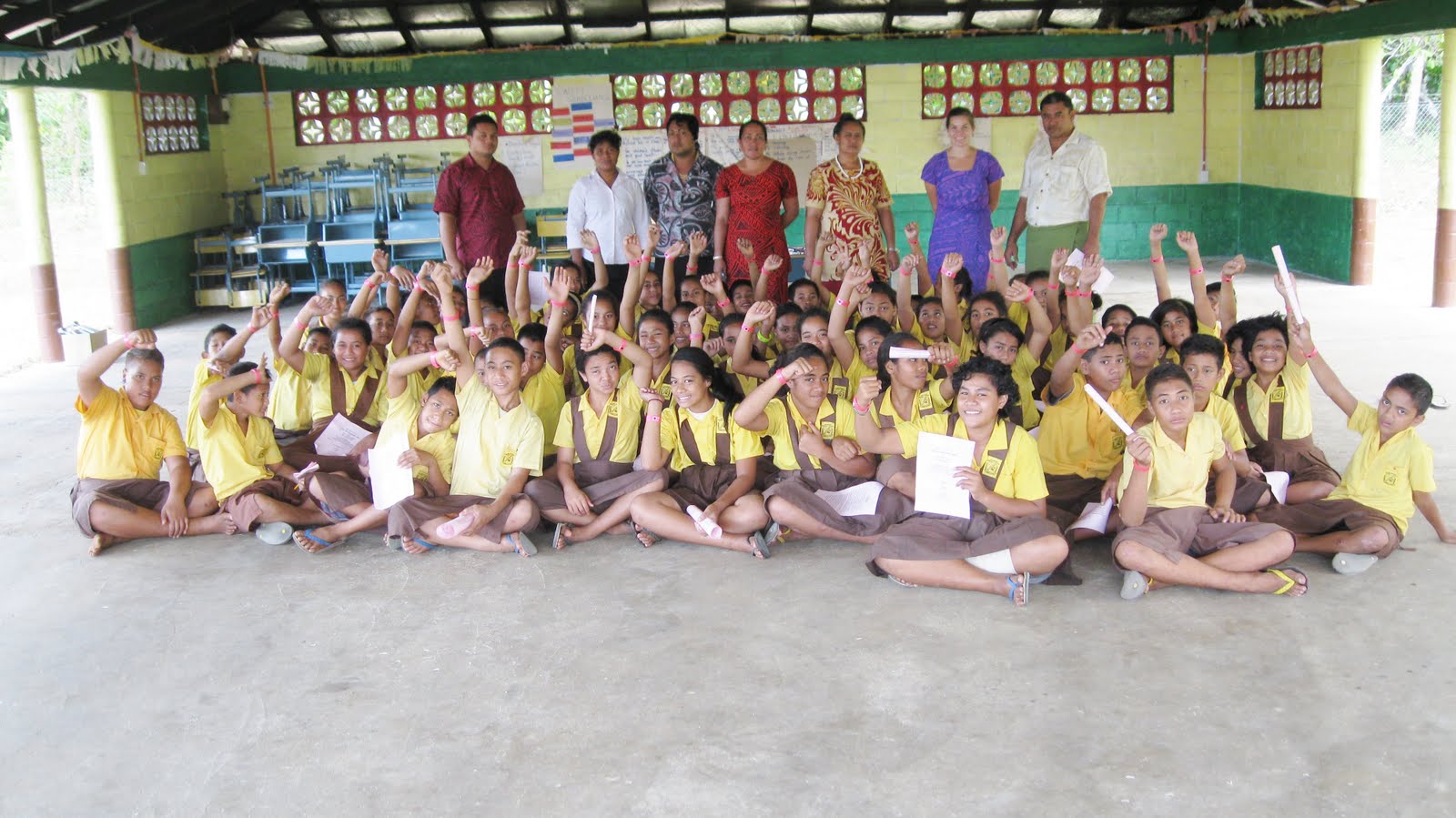
Since all the Peace Corps Volunteers are rural primary school teachers, the program expanded to include students in grades six through eight. The wristbands are a way to get a health tip flyer to their parents. What a hit! The teachers are also drawn into the program as they explain the flyer to the students.


At a resort I was staying, four Australian tourists remarked about driving through a neighboring village with students at the side of the road raising their pink wristbands in the air.


Operation “O le Pokolame Piniki” is off and running.


Devon Childress
Matt Kaplan

Yours truly


Being Female in Samoa

July14, 2011


Living in a traditional society is hard, especially for Westerners. Many join the Peace Corps to be an agent for change. Of course, the change envisioned is to bring your view of enlightenment to others.


Females are particularly prone to this notion as they grapple with their new “lower” status is Samoan society. If you are married, as Mary and I, you find it is your husband who is heard and given credit, even if are the one responsible. If you are female and young, only the strongest in language skills and personality seem to thrive. If you are older and female, you may fall in between. This gap is especially evident during the first year of service.


As time passes, those still here find either Samoans have seen the light you bring or you have seen and figured out how to negotiate your way in the fog. It probably is a mixture of the two with the latter being the predominant hue. Whereas others thought you a complete incompetent before, you now find yourself leading an exercise group at 5:00 am in the morning or having other teachers wonder if some of your methods may have some validity. You may even be contemplating extending your service into a third year. Flip a coin as to who is the wiser.


I being the old, white man with a string of degrees have an easier time of fitting into a more respected role. I can blow into a school, command attention from principle, teachers, and students about the Samoan Challenge whereas the younger female Peace Corps teacher struggle. I can help them get started and give the program a legitimacy they could not.


I do have a lingering question though. I wonder if young females understand their responsibilities to old, white men with a string of degrees when they return home.


Dana Gray
Elisa Law

Lilly Watson

Monday, July 11, 2011

Month Three

July 10, 2011

A village Challenge Group exercising at 5:00 am


Three months have passed since my arrival to respond to a need to complete the second half of a two year Samoan Health Challenge grant. During that time intelligence was gathered, scouting expeditions probed for a pathway, plans were drawn up and revised, now for the battle. Like Pogo of the comic strips, “We have met the enemy and it is us”.


The apathy given to this project, and ergo me, by my the administrations of the “sponsoring organizations”, Women in Business Development and Peace Corps, and by many of the Peace Corps Volunteers is only overshadowed by the responsiveness of the Samoan people. They fully understand their own health predicament and want to be shown a way out. It is when I honestly talk to them face-to-face about what they already suspect, but like all humans, don’t want to face, that I realize the importance of my stay. Their faces are what keep me going.


What is hard to accept is the reality of the NGO and governmental world. This is not the results oriented world, in which I find my reality. It is a world of fulfilling the requirements and budgets of the funder. Results, both long and short term, are of little or consequence. It is the process that matters. So organizations move from fad to fad depending on the “cause d’jour”, be it tsunamis, climate change, obesity, breast feeding, animal rights and all other rights, abuses and all other abuses, inhumanities and all other inhumanities, freedoms and all other freedoms, wherever and whenever good and guilty hearts fork out money, filling out long reports to be filed for posterity only. Mission Accomplished. It is maintaining the organization which counts.


Please don’t misread me. I am not saying this is bad. It is just hard being from one world and trying to exist in another.


My battle plan for the next seven weeks is to engage the enemy, take their money, and do my best to assist those for whom it is intended. Then to get on the plane, return to my family, and say I met the Challenge. I tried.

Wristband Magic

July 8, 2011


For months I have been trying to arrange a meeting with a representative from the Ministry of Health. Finally after two cancelations, I had the opportunity to meet with the Principle Officer for Health Programs arranged by a summer intern in Public Health from the University of California, Berkeley.


The meeting progressed cautiously as we both assessed the other’s motives and interests. The Principle Officer warned me about duplicative and unauthorized programs with possibly conflicting messages. She was skeptical. I was on thin ice as she glanced at her watch.


I then showed her the wristband on my wrist and explained that anyone who pledged to “try” got one as a reminder to themselves and also it served as reinforcement as it had to be explained to others.


“How simple”, she said. “Do you have any extras?” “I want 1,000”


“No problem”, I said,” but how about starting with 500?” “Would you like one on your wrist?”


“Yes. I gained so much weight when I came back from New Zealand”, she said. “I am meeting with the all the department heads this Tuesday and can’t wait to tell them about how I am going to use these wristbands in our new national exercise program aimed at company and organizational employees.”


I also gave her a jar of my mango salsa which is almost as magical as pink wristbands.


Bingo!